
Short answer: A few small studies have reported fewer reflux symptoms in people taking certain probiotics, but the evidence is early and limited, the main U.S. guideline on GERD makes no recommendation on probiotics, and a probiotic isn't a treatment for acid reflux or GERD. If you take one and also deal with reflux, timing is mostly about comfort and consistency: follow the directions on the label, pick a time you can stick to, and if a capsule on an empty stomach bothers you, take it with a light meal instead. Frequent heartburn is worth a conversation with your doctor.
What acid reflux is
Acid reflux happens when stomach contents flow back up into the esophagus, the tube that carries food from your mouth to your stomach. The ring of muscle at the bottom of the esophagus normally keeps that from happening. When it relaxes at the wrong time, you can feel heartburn (a burning feeling behind the breastbone), a sour taste or regurgitation.
Occasional reflux after a big or late meal is common. Reflux that happens often, or that keeps coming back, can be a sign of gastroesophageal reflux disease (GERD), which needs a doctor's diagnosis and care.
Can probiotics help with acid reflux or GERD?
Nobody can say so with confidence yet. Here is where the research stands:
- What studies found. A 2020 systematic review in the journal Nutrients pulled together 13 studies of probiotics in adults with reflux and other upper digestive symptoms. Of 14 comparisons, 11 reported some benefit for upper digestive symptoms. Only 5 of those 11 reported less regurgitation, and one study reported an improvement in reflux or heartburn. The rest concerned symptoms such as indigestion, nausea or gas (Cheng and Ouwehand, 2020).
- The limits. The reviewers rated only 5 of the studies as good quality and noted that the studies measured different symptoms in different ways. They used different strains and products, so a result for one doesn't carry over to another. Both authors worked for a company that makes probiotic ingredients, and the company funded the review.
- What guidelines say. The American College of Gastroenterology's 2022 guideline on GERD makes no recommendation on probiotics (ACG, 2022).
- What standard care includes. The U.S. National Institute of Diabetes and Digestive and Kidney Diseases lists lifestyle changes, medicines such as antacids, H2 blockers and proton pump inhibitors, and in some cases surgery as treatments for GERD. Probiotics aren't on that list (NIDDK).
In practice: a probiotic doesn't replace reflux treatment, and none of this research tested Natren's products. Natren does not claim that any of its products treats, prevents or relieves heartburn, acid reflux or GERD. If your doctor has prescribed a reflux medicine, keep taking it as directed.
Can probiotics cause acid reflux or make it worse?
Heartburn and reflux are not among the side effects U.S. health agencies list for probiotics, but side effects are not tracked well in probiotic research. If heartburn starts or gets worse after a new supplement, stop taking it and talk to your healthcare professional. Our guide can probiotics cause heartburn or acid reflux? covers the evidence.
How to time a probiotic if you get reflux
Start with the label
Your product's label is the first place to look. It gives the serving size, when to take it and how to store it. With Natren products, the label also tells you whether to keep the bottle refrigerated, which matters more than the exact time of day.
Morning or evening
Many people take a probiotic in the morning because it's easy to tie to a routine, such as breakfast or brushing your teeth. If your reflux tends to flare at night, you may prefer not to take anything right before lying down. There's no single best time that suits everyone. The best time is the one you'll keep. Our probiotic timing guide walks through the common options.
With food or on an empty stomach
If taking a capsule on an empty stomach leaves you uncomfortable, try taking it with a light meal. Take capsules with a full glass of water and stay upright for a while afterwards.
If you take other medicines
If you take an acid-reducing medicine or any other prescription, ask your pharmacist whether you need to space your probiotic and other supplements around it. If you're on antibiotics, see taking probiotics with antibiotics for timing.
Be consistent
Whatever time you pick, take your probiotic at about the same time most days. It's easier to remember, and it gives you a fair basis for judging how you get on with it. Read how do I know if my probiotic is working?
Everyday habits that help with reflux
The U.S. National Institute of Diabetes and Digestive and Kidney Diseases describes these steps for reflux symptoms (NIDDK):
- Finish eating at least 3 hours before you lie down.
- Raise the head of your bed by 6 to 8 inches if heartburn bothers you at night.
- Notice which foods and drinks trigger it for you. Ones commonly linked to symptoms include high-fat foods, chocolate, mint, coffee, alcohol, citrus, tomato and spicy dishes.
- If you smoke, stopping helps.
Choosing a probiotic
If you decide to take a probiotic, choose one whose label names each strain and guarantees the count through the expiration date, not just at manufacture. Our buyer's guide and our guide to reading a probiotic label show what to look for.
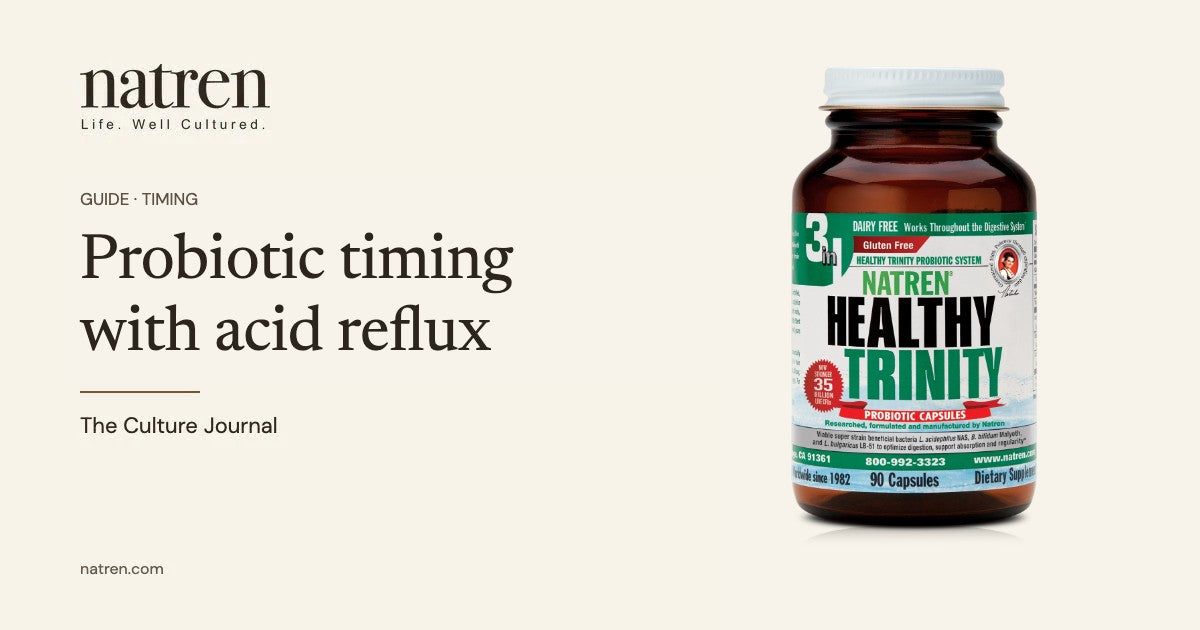
Natren's Healthy Trinity combines three named strains, Lactobacillus acidophilus NAS, Bifidobacterium bifidum Malyoth and Lactobacillus bulgaricus LB-51, in an oil-based capsule. This is general product information, not a recommendation for heartburn or reflux. If you'd rather not swallow capsules, see chewables vs capsules vs powders.
Talk to a clinician before using any probiotic if you or the person you care for has a weakened immune system, is seriously ill or in hospital, or is a premature infant. The National Center for Complementary and Integrative Health notes that the risk of harmful effects is greater in people with severe illnesses or weakened immune systems (NCCIH).
When to talk to a doctor
NIDDK says to see a doctor if you think you have GERD, or if your symptoms don't get better with over-the-counter medicines or lifestyle changes. It also says to see a doctor for symptoms that could point to complications or another serious problem (NIDDK):
- chest pain
- loss of appetite
- persistent vomiting
- problems swallowing or pain while swallowing
- vomit that contains blood or looks like coffee grounds
- stool that contains blood or looks black and tarry
- unexplained weight loss
Chest pain isn't always heartburn. The CDC lists chest pain or discomfort, shortness of breath, pain in the jaw, neck, back, arms or shoulders, and feeling weak, light-headed or faint as major symptoms of a heart attack. If you notice them, call 9-1-1 immediately (CDC).
Frequently asked questions
Do probiotics help with acid reflux or GERD?
Some small studies report fewer symptoms, but the research is early and mixed in quality, and probiotics aren't part of standard GERD treatment. Talk to your doctor about symptoms that are frequent or keep returning.
Can I take a probiotic with my reflux medicine?
Ask your pharmacist or doctor, who can check your specific medicines and tell you whether to space them. Do not stop or replace a reflux medicine with a supplement.
Is morning or night better?
Neither is right for everyone. Follow the label, and choose the time you'll stick with. If night-time reflux bothers you, morning may be more comfortable.
Should I take a probiotic on an empty stomach?
Follow your label. If an empty stomach is uncomfortable for you, a light meal is a reasonable alternative.
Sources
- Cheng J, Ouwehand AC. Gastroesophageal Reflux Disease and Probiotics: A Systematic Review. Nutrients. 2020;12(1):132. https://pmc.ncbi.nlm.nih.gov/articles/PMC7019778/
- Katz PO, Dunbar KB, Schnoll-Sussman FH, et al. ACG Clinical Guideline for the Diagnosis and Management of Gastroesophageal Reflux Disease. Am J Gastroenterol. 2022;117(1):27-56. https://pmc.ncbi.nlm.nih.gov/articles/PMC8754510/
- National Institute of Diabetes and Digestive and Kidney Diseases. Treatment for GER & GERD. Last reviewed July 2020. https://www.niddk.nih.gov/health-information/digestive-diseases/acid-reflux-ger-gerd-adults/treatment
- National Institute of Diabetes and Digestive and Kidney Diseases. Eating, Diet, & Nutrition for GER & GERD. Last reviewed July 2020. https://www.niddk.nih.gov/health-information/digestive-diseases/acid-reflux-ger-gerd-adults/eating-diet-nutrition
- National Institute of Diabetes and Digestive and Kidney Diseases. Symptoms & Causes of GER & GERD. Last reviewed July 2020. https://www.niddk.nih.gov/health-information/digestive-diseases/acid-reflux-ger-gerd-adults/symptoms-causes
- Centers for Disease Control and Prevention. About Heart Attack Symptoms, Risk, and Recovery. Updated October 24, 2024. https://www.cdc.gov/heart-disease/about/heart-attack.html
- National Center for Complementary and Integrative Health. Probiotics: Usefulness and Safety. Last updated August 2019. https://www.nccih.nih.gov/health/probiotics-usefulness-and-safety
Updated November 15, 2026. Sources checked November 15, 2026.
These statements have not been evaluated by the Food and Drug Administration. These products are not intended to diagnose, treat, cure, or prevent any disease.


