
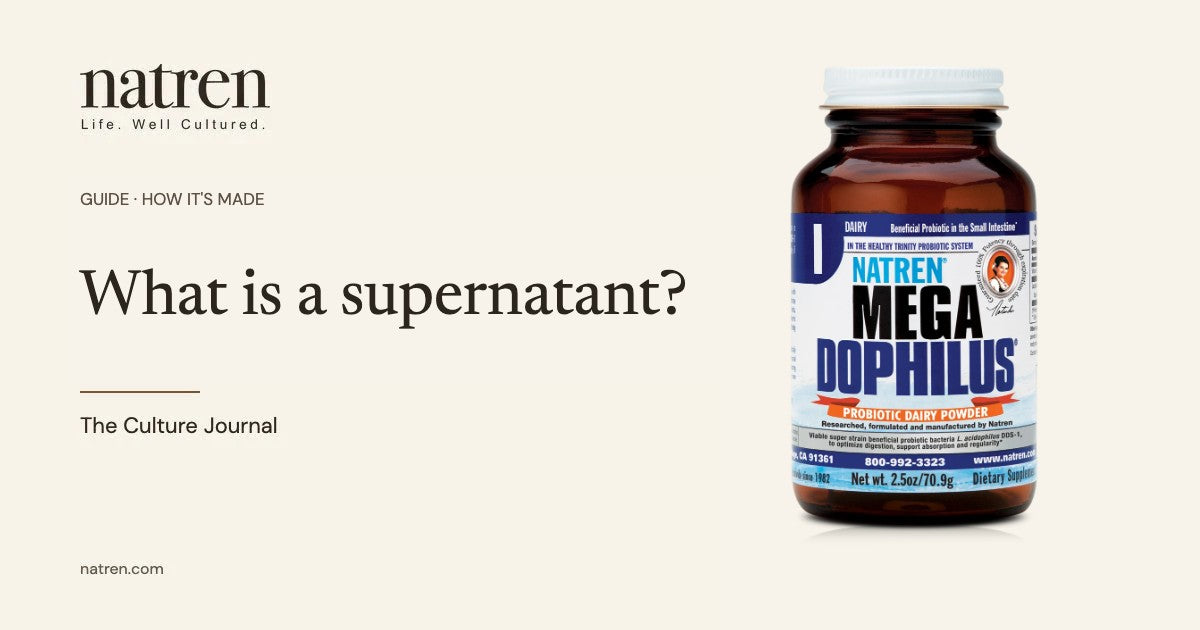
Short answer: A supernatant is the liquid left after probiotic bacteria have grown in their culture medium. It holds what the bacteria made while they grew, such as lactic acid and other natural byproducts. Many manufacturers separate the bacteria and discard that liquid. Natren keeps it: its single-strain probiotics, including Megadophilus, Bifido Factor and Digesta-Lac, are labeled "supernatant fortified".
How probiotic bacteria are grown
Probiotic strains are grown in large tanks of culture medium, a nutrient base chosen to suit each strain. As the bacteria multiply, they use up those nutrients and release substances of their own into the liquid. Lactobacilli, for example, produce lactic acid. When growth is finished, the tank holds two things: the bacteria themselves, and the liquid around them.
In a lab, spinning a sample in a centrifuge separates the two. The bacteria settle to the bottom, and the liquid on top is the "supernatant", from the Latin for "floating above".
Two ways to make a probiotic
- Separate and discard. Many manufacturers concentrate the bacteria and throw the supernatant away. The concentrated bacteria are then freeze-dried, and a carrier such as a starch or other filler is often added to make up a measurable powder.
- Keep the whole culture. Natren freeze-dries its single-strain probiotics with the supernatant retained. Freeze-drying removes the water and holds the bacteria in a dormant state until you take them. Keeping the supernatant means more material to freeze-dry, which costs more.
Natren's view is that the culture is more complete with its supernatant left in, which is why it doesn't need to add prebiotics such as FOS to its formulas. See what FOS is and why Natren doesn't add it.
Which Natren products are supernatant fortified?
- Megadophilus: Lactobacillus acidophilus NAS, as capsules and powders, in dairy, dairy-free and vegan versions
- Bifido Factor: Bifidobacterium bifidum Malyoth
- Digesta-Lac: Lactobacillus bulgaricus LB-51
- Life Start Vegan: Bifidobacterium infantis NLS
The product labels say "supernatant fortified". Healthy Trinity takes a different approach: its three strains are held in an oil-based capsule, Natren's Oil Matrix Delivery System, which keeps each strain separate. Read why Natren keeps strains separate.
What to look for on any probiotic label
- Each strain named in full, such as L. acidophilus NAS.
- The CFU count, and whether it's guaranteed through the expiration date.
- The other ingredients, including carriers, fillers and added prebiotics.
- Storage directions.
Our buyer's guide covers each of these, and the strain guide explains Natren's strains, including NAS, Malyoth and LB-51.
Frequently asked questions
Is the supernatant an added ingredient?
No. It's part of the original culture: what the bacteria grew in and produced. It's kept rather than removed.
Does supernatant change how I take the product?
No. Follow the serving size and storage directions on the label.
Why do Natren products need refrigeration?
Storage directions depend on the product, so check its label. Our refrigeration guide explains refrigerated and shelf-stable probiotics.
These statements have not been evaluated by the Food and Drug Administration. These products are not intended to diagnose, treat, cure or prevent any disease.


Join the conversation