
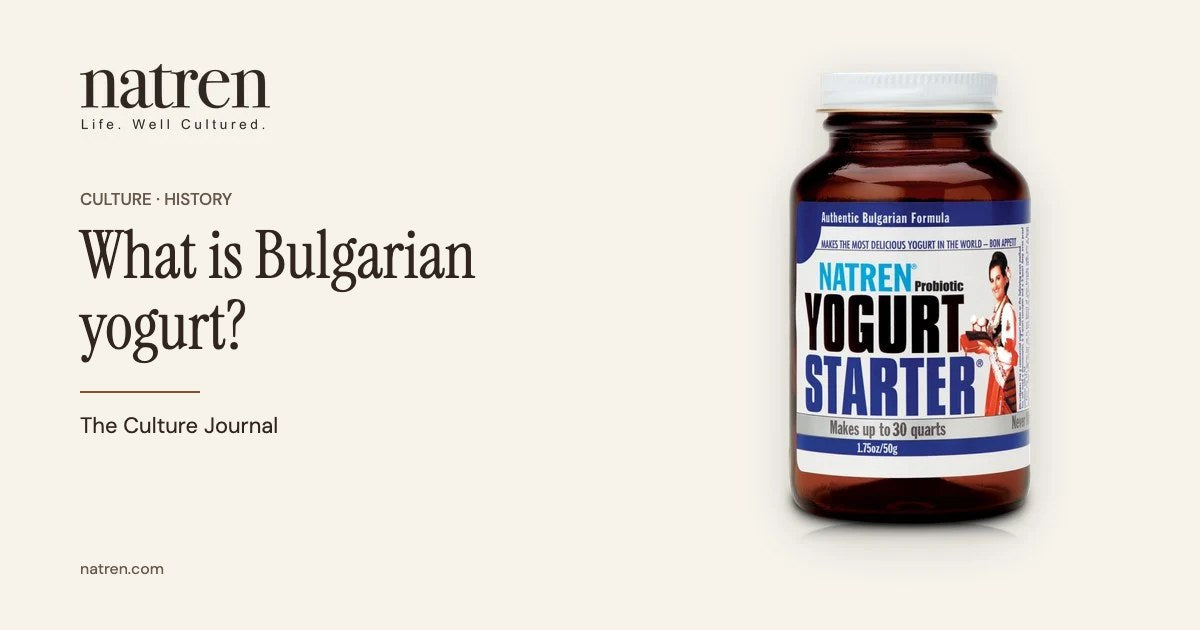
Short answer: Bulgarian yogurt is yogurt made the traditional Bulgarian way, with two cultures: Lactobacillus bulgaricus and Streptococcus thermophilus. It's plain, unstrained and noticeably tangy, with a looser, silkier texture than Greek yogurt. You can make it at home with nothing but milk and a starter that contains those two cultures, such as Natren Yogurt Starter.
What makes yogurt "Bulgarian"?
In Bulgaria, yogurt is called kiselo mlyako, which means "sour milk", and it's eaten every day, at breakfast, lunch and dinner. What sets it apart is the culture, not a brand or a recipe. Traditional Bulgarian yogurt is fermented by just two bacteria working together:
- Lactobacillus bulgaricus, a rod-shaped bacterium that gives the yogurt its sharp, clean tang. Today its full scientific name is Lactobacillus delbrueckii subsp. bulgaricus.
- Streptococcus thermophilus, a round bacterium that gets the fermentation going quickly and adds a milder, creamier note.
The two help each other along: each produces something the other uses, so together they turn milk into yogurt faster than either would alone. Most yogurt sold today is built on the same pair, but Bulgarian yogurt keeps it simple: milk and those two cultures, with no thickeners, sweeteners or extra ingredients.
How it tastes and how it differs from Greek yogurt
- Taste: more tart than most supermarket yogurt, especially after a longer incubation.
- Texture: smooth and spoonable, but softer than Greek yogurt because it isn't strained.
- Greek yogurt is yogurt with much of the whey strained off, which makes it thick and dense. You can turn Bulgarian-style yogurt into Greek-style yogurt at home by straining it. See the straining tip in our Instant Pot yogurt guide.
- Regular supermarket yogurt often uses the same two cultures plus others, and many brands add thickeners such as pectin or gelatin, or sweeteners.
Where the name comes from: Stamen Grigorov, 1905
For centuries nobody knew what turned milk into yogurt. That changed in 1905, when Stamen Grigorov, a Bulgarian medical student in Geneva, looked at yogurt from home under a microscope. He described a rod-shaped bacterium alongside a round one, the same pair described above. The rod-shaped one was named bulgaricus after his home country.
A few years later, Élie Metchnikoff, a Nobel Prize-winning scientist at the Pasteur Institute in Paris, wrote about the long lives of Bulgarian villagers and their daily yogurt. His books made Bulgarian yogurt famous across Europe and America in the early 1900s. Grigorov's home village, Studen Izvor, now has a small museum dedicated to yogurt.
Natren's Bulgarian yogurt story
Natren's founder, Natasha Trenev, grew up with Bulgarian-style yogurt. Her family made yogurt for generations, and after the family moved to California in 1956, her father began making traditional Bulgarian-style yogurt in America. When Natasha founded Natren, she included a yogurt starter based on that family recipe.
Today, Natren Yogurt Starter combines L. bulgaricus LB-51 and S. thermophilus BC 122. LB-51 is Natren's own L. bulgaricus strain. One bottle makes up to 30 quarts of yogurt, and the starter contains no gums, additives, sweeteners or preservatives. You can read more about LB-51 in our strain guide.
How to make Bulgarian yogurt at home
The method is the same as for any homemade yogurt. With Natren Yogurt Starter and 2 quarts of milk:
- Heat the milk to 180–190°F (82–88°C) and hold it there for 20 to 40 minutes, in a double boiler so it doesn't scorch.
- Cool it to 110–112°F (43–44°C). Don't let it drop below 110°F.
- Add the starter: mix 1 to 2 level teaspoons with a little of the cooled milk to make a smooth paste, then stir it into the rest.
- Incubate somewhere warm for about 4 to 8 hours, until it sets like custard. Longer gives a tangier, more Bulgarian taste.
- Chill for several hours before eating. Pour off any whey on top.
For every detail, including milk choices and troubleshooting, see our full guide to making yogurt at home. Using an Instant Pot? Follow the Instant Pot yogurt guide instead.
How Bulgarians eat it
- Plain, by the bowlful, sometimes with honey and walnuts.
- Tarator, a cold summer soup: plain yogurt thinned with cold water, with diced cucumber, crushed garlic, dill, walnuts, a little oil and salt.
- Snezhanka ("Snow White") salad: thick, strained yogurt mixed with chopped cucumber, garlic, dill and walnuts.
- Ayran, a drink of yogurt whisked with cold water and a pinch of salt.
For more ideas, try our green yogurt recipes.
FAQ
Is Bulgarian yogurt the same as kefir?
No. Kefir is fermented with a mix of many bacteria and yeasts and is usually drinkable. Bulgarian yogurt is made with just two bacteria and sets into a spoonable yogurt.
Can I use store-bought Bulgarian yogurt as a starter?
You can, but you won't know exactly which cultures you're adding or how many are still live, and results vary from batch to batch. A measured starter gives more predictable yogurt. Natren recommends starting each batch with fresh Yogurt Starter.
Why is my homemade Bulgarian yogurt runny?
Usually the milk cooled below 110°F before the starter went in, too little starter was used, or it didn't incubate long enough. Our yogurt guide has a full troubleshooting section.
Does Bulgarian yogurt have to be made with cow's milk?
Traditionally it's made with cow's, sheep's or buffalo milk. Natren's directions also cover goat's milk, which sets thinner.


Join the conversation