
Short answer: Probiotics are live microorganisms. Prebiotics are what certain gut microbes use as food, mostly types of fiber. Postbiotics are microorganisms that have been deliberately inactivated, together with their components. The three words sound alike but describe different things, and each one has a definition agreed by an international panel of scientists.
The terms at a glance
| Term | What it is | Alive? | Examples |
|---|---|---|---|
| Probiotic | Live microorganisms that, when consumed in adequate amounts, provide a benefit to the person taking them | Yes | Supplements with named strains, such as Lactobacillus acidophilus NAS |
| Prebiotic | A substance that particular microbes living in the body use selectively, in a way that benefits the host | Not a microbe | Certain fibers, such as inulin and FOS, found in onions, garlic, leeks, asparagus and chicory root |
| Postbiotic | A preparation of inanimate (non-living) microorganisms and/or their components that benefits the host | No, inactivated | Preparations made from identified strains that have been inactivated, for example by heat |
| Synbiotic | A mixture of live microorganisms and a substance that microbes in the body use selectively | Contains live microbes | A supplement that combines a probiotic with a prebiotic such as FOS |
Each definition includes a benefit as part of what qualifies something for the category. That is the scientific standard for the term, not a promise about any particular product.
Probiotics: alive and identified
The widely used definition of a probiotic comes from a 2001 expert consultation of the Food and Agriculture Organization and the World Health Organization, and it was reaffirmed by the International Scientific Association for Probiotics and Prebiotics (ISAPP) in 2014. Three parts of it matter when you shop:
- Live. A probiotic has to be alive when you take it, which is why storage and the expiration date matter.
- Identified. Researchers study probiotics strain by strain, so a good label names each strain in full: genus, species and strain designation. Our strain guide explains how to read those names.
- An adequate amount. The amount is given in colony forming units (CFUs). A count guaranteed through the expiration date tells you more than a count at the time of manufacture. Our article on probiotic stability explains why.
Prebiotics: food for some gut microbes
ISAPP's 2017 definition describes a prebiotic as a substance that microorganisms living in the body use selectively, in a way that benefits the host. "Selectively" is the important word: a prebiotic feeds particular microbes rather than everything in the gut. That's why not every fiber counts as a prebiotic.
The best-studied prebiotics are fibers such as inulin, fructooligosaccharides (FOS) and galactooligosaccharides (GOS). Many everyday foods contain them, including onions, garlic, leeks, asparagus, bananas, oats, beans and whole grains. Some supplements add FOS or inulin, and some people notice gas or bloating from them. Our article on what FOS is covers how to spot it on a label.
Postbiotics: inactivated microbes
"Postbiotic" is the newest of the terms. In 2021, an ISAPP panel defined it as a preparation of inanimate microorganisms and/or their components that confers a health benefit on the host. Under that definition:
- The microbes must be identified first. A postbiotic starts from characterized microorganisms, which are then deliberately inactivated, for example with heat.
- Components count, alongside the cells. The preparation can include parts of the microbes and substances they made.
- Purified compounds on their own don't. The panel excluded substantially purified metabolites, such as short-chain fatty acids, and cell-free filtrates. Those are studied in their own right, but they aren't postbiotics.
Research on postbiotics is still developing, and the term is newer to labels than "probiotic" or "prebiotic".
Where a supernatant fits
Natren's single-strain probiotics are labeled "supernatant fortified". The supernatant is the liquid the bacteria grew in, and Natren keeps it along with the live bacteria rather than discarding it. These products are probiotics: the live, identified cultures are the point. A cell-free supernatant on its own would not be a postbiotic under the ISAPP definition. Read what a supernatant is and why Natren keeps it.
Synbiotics: two in one
A synbiotic, as defined by ISAPP in 2020, is a mixture of live microorganisms and a substance that microbes in the body use selectively. In practice it is often a probiotic with an added prebiotic such as FOS or inulin. Natren keeps its formulas to named strains and doesn't add FOS or other prebiotics.
How to read the label
- Probiotics: every strain named in full, the CFU count and whether it holds through expiration, and storage directions.
- Prebiotics: look for inulin, FOS or fructooligosaccharides, chicory root, or GOS in the Supplement Facts panel or the other ingredients.
- Postbiotics: look for the identity of the microorganism the product was made from and how it was inactivated. Because the microbes aren't alive, a live CFU count doesn't apply.
- "Biotic" blends: check exactly what's in them, and in what amounts.
Our probiotic buyer's guide goes through the rest of the label.
Where Natren fits
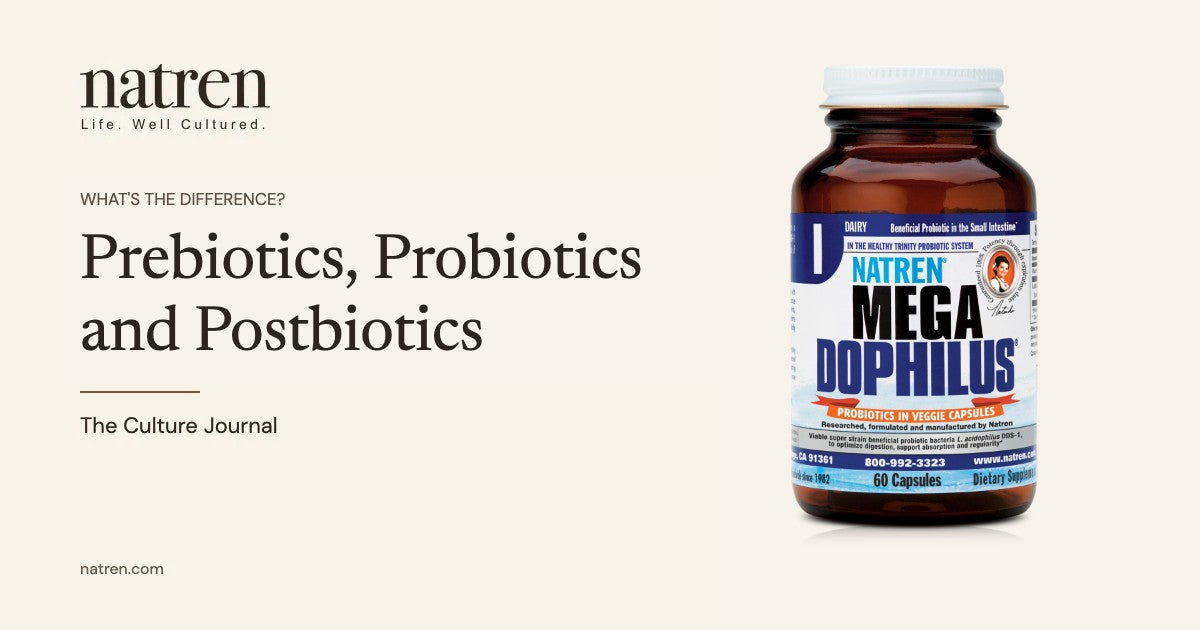
Natren makes probiotics: live cultures with every strain named on the label, counts guaranteed through the expiration date when stored as directed, and products kept refrigerated and shipped cold. Healthy Trinity combines L. acidophilus NAS, B. bifidum Malyoth and L. bulgaricus LB-51 in one oil-based capsule. Megadophilus, Bifido Factor and Digesta-Lac each offer a single, supernatant-fortified strain. For prebiotic fibers, everyday foods are the place to start; Microbiota 101 explains how diet shapes the gut community.
Follow the label, and talk with your doctor before starting any supplement if you are pregnant or nursing, take medication or have a health condition.
Frequently asked questions
Are postbiotics just dead probiotics?
Close, but the scientific definition is narrower. The microorganisms must be identified before they are deliberately inactivated, and the preparation can include their components. Purified metabolites or a cell-free filtrate on their own don't count.
Do I need a prebiotic with my probiotic?
Not necessarily. Many everyday foods supply prebiotic fibers, including onions, garlic, leeks, asparagus, bananas, oats and beans. Natren's probiotics don't contain added prebiotics.
Is yogurt a probiotic?
Yogurt is made with live cultures, but scientists reserve "probiotic" for identified microorganisms in an adequate amount. Our article on probiotic supplements vs yogurt compares the two.
Sources
- Hill C, et al. ISAPP consensus statement on the scope and appropriate use of the term probiotic (2014), Nature Reviews Gastroenterology & Hepatology
- Gibson GR, et al. ISAPP consensus statement on the definition and scope of prebiotics (2017), Nature Reviews Gastroenterology & Hepatology
- Swanson KS, et al. ISAPP consensus statement on the definition and scope of synbiotics (2020), Nature Reviews Gastroenterology & Hepatology
- Salminen S, et al. ISAPP consensus statement on the definition and scope of postbiotics (2021), Nature Reviews Gastroenterology & Hepatology
- Probiotics: Fact Sheet for Consumers, NIH Office of Dietary Supplements
These statements have not been evaluated by the Food and Drug Administration. This product is not intended to diagnose, treat, cure or prevent any disease.


Join the conversation