
Short answer: Bifidobacterium infantis is a bacterium found in many breastfed babies. It's known for using the special sugars in breast milk that babies can't digest themselves. If you're thinking about a B. infantis probiotic for your baby, talk to your pediatrician first, check the label's base ingredients and directions, and keep it refrigerated. Don't give any probiotic to a baby who was born early, has a weakened immune system or is in the hospital unless the baby's medical team recommends it.
What B. infantis is
Bifidobacteria are a group of bacteria first described in 1899 in the stools of breastfed babies. B. infantis is one of them; today it's classified as B. longum subsp. infantis. Breast milk contains human milk oligosaccharides (HMOs), complex sugars that a baby can't digest. Researchers have found that B. infantis is particularly well equipped to use them, which is why it's closely linked with breastfed babies. Read more in our B. infantis strain guide.
Why parents ask about it
Studies comparing babies in different countries have found that B. infantis is common in breastfed babies in some places but much less common in babies in the United States and Europe. Researchers are still studying why. Feeding, birth by C-section and antibiotics are among the factors being looked at. What these differences mean for any one baby isn't settled, and a probiotic isn't a substitute for your pediatrician's advice about feeding or your baby's health.
Questions to ask your pediatrician
- Is a probiotic appropriate for my baby, given their age, health and how they were born?
- Which base ingredients should we avoid (for example, cow's milk or goat milk if there's a milk allergy in the family)?
- How much should I give, and how should I mix it?
- What should I watch for, and when should I call?
Choosing a product: what to check on the label
- The strain name. Look for genus, species and strain, such as Bifidobacterium infantis NLS, not just "probiotic blend".
- The base ingredients. Infant probiotic powders are made in a base such as milk, goat milk or rice. That matters if your baby has a milk allergy.
- The count through expiration. A count guaranteed through the expiration date tells you more than a count "at time of manufacture".
- The directions. The serving, how to mix it and any age limits.
- Storage. Whether it needs refrigeration, and how long it lasts once opened.
Natren's Life Start family
Natren's B. infantis products feature a single strain, NLS, in different bases:
- Life Start: a powder in a milk-containing (cow's milk) base.
- Life Start Vegan: a dairy-free powder, free from soy and FOS, with 1 billion CFU per 1 g serving.
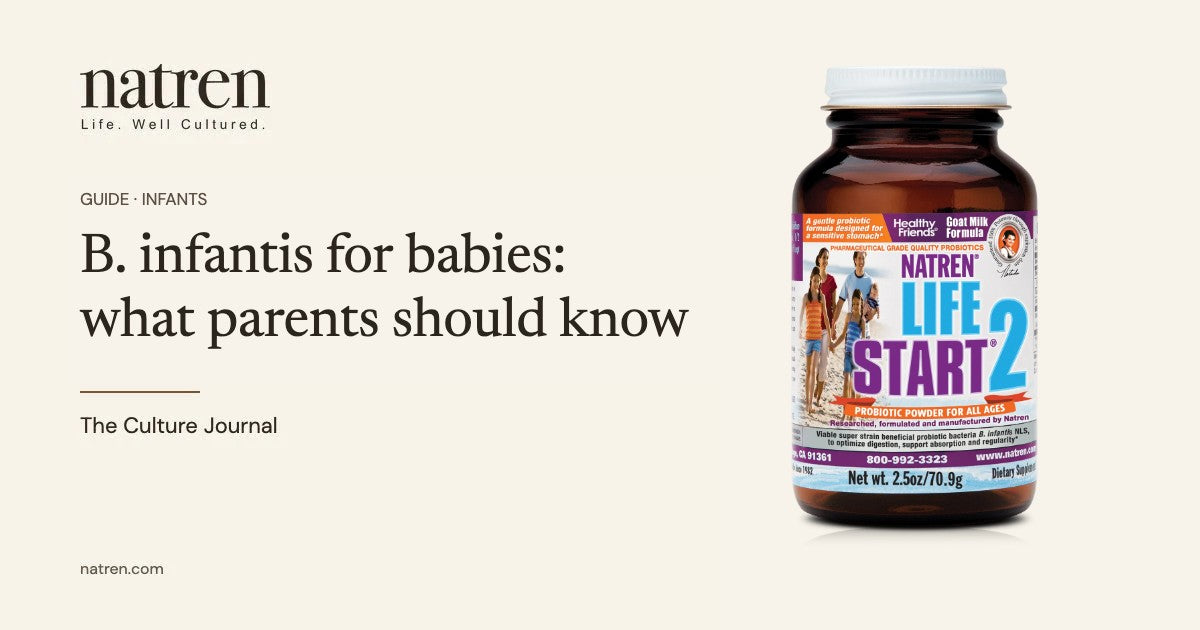
- Life Start 2: a goat-milk-based powder. Goat milk is still milk, so ask your pediatrician if there's a milk allergy. Life Start 2 also comes as capsules, which aren't for children under 8 because of the choking risk.
Each label guarantees the count through the expiration date when the product is kept refrigerated, and advises asking your pediatrician before use for infants and children.
How to give a probiotic powder to a baby
- Follow the label or your pediatrician for the amount. The Life Start and Life Start Vegan directions describe about ¼ teaspoon.
- Mix it into a small amount of unchilled liquid. Life Start's directions mention unchilled water, breast milk, formula or soft food; Life Start Vegan's mention unchilled filtered water. For toddlers, Life Start Vegan's label also mentions non-acidic juice, applesauce or yogurt.
- Never add it to anything hot. Heat can damage live cultures.
- Use a clean fingertip, spoon or oral syringe, as the label suggests.
- Space it from medicines and supplements: the labels say to keep at least two hours apart.
- Change one thing at a time, so you can tell what's behind any change.
Storage
Keep Life Start refrigerated, with the lid tight, and don't freeze it. Use a clean, dry spoon each time so moisture doesn't get into the bottle. When you travel, keep it cool and put it back in the fridge as soon as you can. Read do probiotics need to be refrigerated?
Safety first
In 2023 the FDA warned healthcare providers about the risk of serious infection when probiotic products are given to preterm infants in the hospital, after a premature baby died of an infection linked to a probiotic product. If your baby was born early, has a weakened immune system, has a medical condition or is in the hospital, only use a probiotic if their medical team recommends it.
Stop and call your pediatrician if your baby has a rash or hives, vomiting, blood in the stool, a fever, poor feeding, unusual sleepiness, or fussiness that doesn't settle. Call 911 or your local emergency number if your baby has trouble breathing, swelling of the face or lips, or is hard to wake. If your baby seems unsettled after starting a probiotic, see why some babies react to probiotics.
Frequently asked questions
Can I mix B. infantis powder into breast milk or formula?
Life Start's directions list breast milk and formula as options. Use a small amount so your baby gets the whole serving, and never mix it into anything hot.
Can a nursing mother take Life Start?
Natren describes the Life Start powders as made for infants, toddlers and expecting and nursing mothers. Check with your own healthcare provider.
Which Life Start is dairy-free?
Life Start Vegan. Life Start contains cow's milk and Life Start 2 is goat-milk based.
What about older children?
See our guide to Natren probiotics for kids by age and format.
These statements have not been evaluated by the Food and Drug Administration. These products are not intended to diagnose, treat, cure or prevent any disease.


Join the conversation