
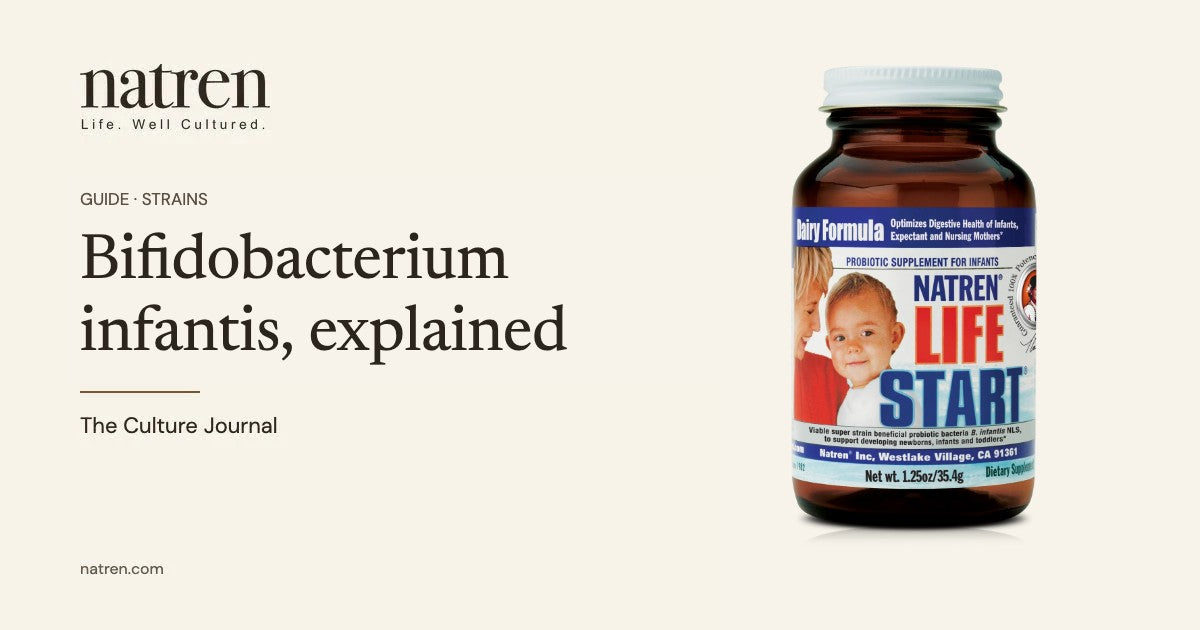
Short answer: Bifidobacterium infantis is a bifidobacterium named for the infants it was first found in. It's known for being able to use the sugars in human breast milk that babies can't digest themselves, and it's one of the bacteria commonly found in breastfed babies. Scientists now classify it as a subspecies, B. longum subsp. infantis, but "B. infantis" is still the name you'll see on most labels. Natren's strain is NLS, found in the Life Start family.
What is Bifidobacterium infantis?
Bifidobacteria are a group of bacteria named for their forked, Y-shaped cells. B. infantis is one of them. Like other bifidobacteria, it grows without oxygen and produces lactic and acetic acids from the sugars it ferments.
- Where it's found: in the gut of many breastfed infants. Its numbers usually fall as a baby moves on to solid foods.
- What it's known for: using human milk oligosaccharides (HMOs), complex sugars in breast milk that a baby can't digest. Researchers have described B. infantis as unusually well equipped to use the full range of them.
- What it needs: no oxygen, which is part of why careful manufacturing and cold storage matter for bifidobacteria products.
A short history
In 1899, the French pediatrician Henri Tissier described Y-shaped bacteria in the stools of breastfed babies at the Pasteur Institute in Paris. Those were the first bifidobacteria. B. infantis was later described as its own species, and in 2002 scientists reclassified it as a subspecies of Bifidobacterium longum. You'll see both names in research, and both refer to the same organism.
Why it's in the news
Studies comparing infants around the world have found that B. infantis is common in breastfed babies in some countries but much less common in babies in the United States and Europe, where other bifidobacteria tend to dominate. Researchers are still working out why. Feeding patterns, birth by C-section and antibiotic use are among the factors being studied. What, if anything, those differences mean for an individual baby isn't settled.
Why the strain matters
"B. infantis" names the subspecies, not the exact culture. Different strains can behave differently, so research on one strain can't simply be applied to another. The strain code on a label, such as NLS, tells you exactly which culture a product contains. Our strain guide explains all of Natren's strain names.
Natren's NLS strain
Bifidobacterium infantis NLS is Natren's B. infantis strain. Here's how Natren handles it:
- Grown by Natren in its own manufacturing facility in California.
- Supernatant fortified in Life Start Vegan: the culture medium NLS is grown in, an organic brown rice base, stays in the finished product.
- Kept cold: NLS products are refrigerated and shipped cold, and should be kept refrigerated at home, not frozen.
- Counts guaranteed through expiration when stored as directed.
Which Natren products contain NLS
- Life Start: a powder in a milk-containing (cow's milk) base, in 1.25, 2.5 and 4.5 oz bottles.
- Life Start Vegan: a dairy-free powder, also free from soy and FOS, with 1 billion CFU of NLS per 1 g serving, in a 1.25 oz bottle.
- Life Start 2: goat-milk based, as a powder (2.5 or 4.5 oz) or capsules (60 or 90). Capsules aren't for children under 8 because of the choking risk.
- Trenev Duo, from Natren's ProTren line: 10 billion CFU of NLS and 10 billion CFU of B. longum NBL per 2-capsule serving, with 200 mg of 2'-fucosyllactose (2'-FL), a human milk oligosaccharide.
Natren describes the Life Start powders as made for infants, toddlers and expecting and nursing mothers. For infants and children, the labels advise asking your pediatrician before use. See the Life Start collection, and for babies specifically, read B. infantis for babies: what parents should know.
Taking and storing an NLS product
- Follow the label for the serving and how to mix it. Life Start powders mix into a small amount of unchilled water; Life Start's directions also mention breast milk, formula or soft food. Never add them to anything hot.
- Space it from medicines: the directions say to take Life Start products at least two hours apart from herbs, garlic, prescription drugs and other supplements.
- Keep it cold: refrigerate as soon as it arrives, with the lid tight. Read our guide to refrigerated probiotics.
FAQ
Is B. infantis the same as B. longum?
They're closely related. Scientists now classify B. infantis as a subspecies of B. longum. Natren uses B. infantis NLS in Life Start and Trenev Duo, and B. longum NBL in Trenev Duo.
What's the difference between B. infantis and B. bifidum?
They're different species in the same genus. Natren uses B. bifidum Malyoth in Bifido Factor and Healthy Trinity. Read our B. bifidum guide.
Is there a dairy-free B. infantis product?
Yes. Life Start Vegan is dairy-free, and so is Trenev Duo. Life Start and Life Start 2 contain milk.
Can adults take Life Start?
Natren describes the Life Start powders as made for infants, toddlers and expecting and nursing mothers. Natren's product information describes Life Start 2 as suitable for any age, and the capsule form is an option for people who swallow capsules. Check the label, and ask your healthcare provider if you have a health condition.
These statements have not been evaluated by the Food and Drug Administration. These products are not intended to diagnose, treat, cure or prevent any disease.


Join the conversation