
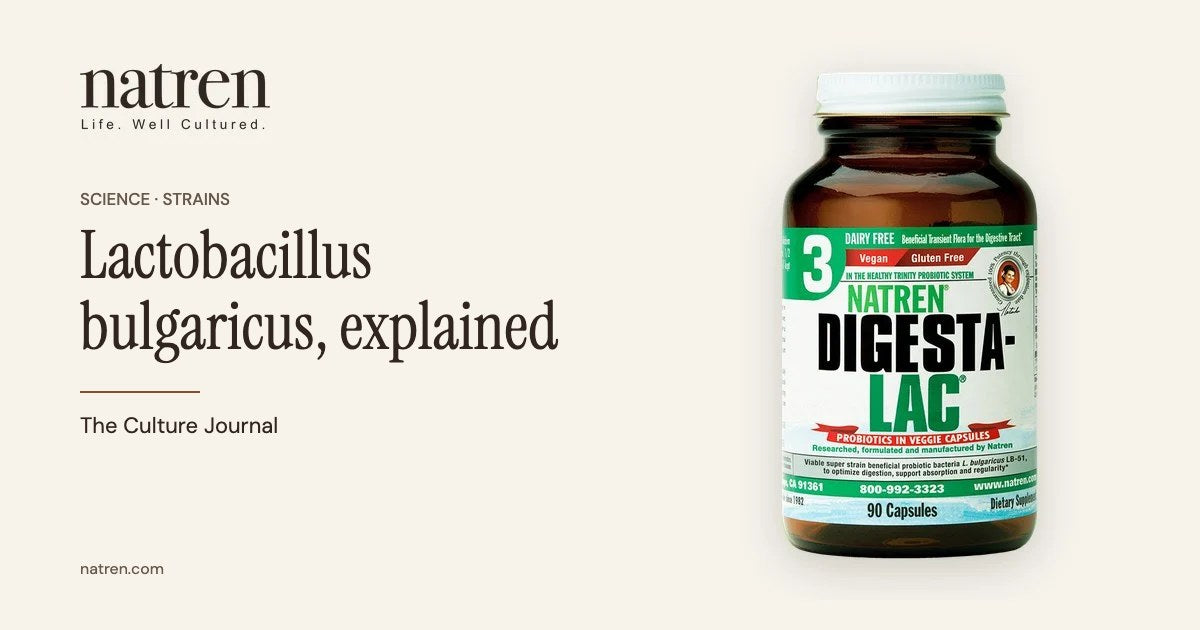
Short answer: Lactobacillus bulgaricus is the classic yogurt bacterium. It was first identified in Bulgarian yogurt in 1905, and it's one of the two cultures, along with Streptococcus thermophilus, that turn milk into yogurt. Its full scientific name today is Lactobacillus delbrueckii subsp. bulgaricus. As with every probiotic species, the strain matters: Natren's strain is L. bulgaricus LB-51, found in Digesta-Lac, Healthy Trinity, Natren's chewable wafers and Yogurt Starter.
What is Lactobacillus bulgaricus?
L. bulgaricus is a rod-shaped lactic acid bacterium. It turns lactose, the sugar in milk, into lactic acid, which is what thickens milk into yogurt and gives it its clean, sharp tang.
- Warmth-loving: it grows best at warm temperatures, around 110°F (43°C) and above, which is why yogurt is incubated warm.
- A team player: in yogurt it works alongside S. thermophilus. Each produces something the other uses, so together they ferment milk faster than either does alone.
- The name: it's named after Bulgaria, where it was discovered. In the 1980s, scientists grouped it as a subspecies of Lactobacillus delbrueckii, which is why you'll see both names. It kept the Lactobacillus genus name in the 2020 reclassification.
A short history
In 1905, Stamen Grigorov, a Bulgarian medical student working in Geneva, examined yogurt from home under a microscope and described the rod-shaped bacterium that now carries his country's name. A few years later, the scientist Élie Metchnikoff made Bulgarian yogurt famous across Europe and America. Read the full story in What Is Bulgarian Yogurt?
Why the strain matters
"L. bulgaricus" on a label names only the species. Within it there are many strains, and they can behave differently, so research on one strain can't simply be applied to another. The strain code, such as LB-51, tells you exactly which culture a product contains. Our strain guide explains all of Natren's strain names, and our acidophilus guide covers how to read a full probiotic name.
Natren's LB-51 strain
Lactobacillus bulgaricus LB-51 is Natren's L. bulgaricus strain, and it ties back to the company's roots: Natren's founder grew up with traditional Bulgarian-style yogurt. Here's how Natren handles it:
- Grown by Natren in its own manufacturing facility in California.
- Supernatant fortified in Digesta-Lac: the culture medium LB-51 is grown in is kept in the finished product rather than filtered out.
- Kept cold: LB-51 products are refrigerated and shipped cold, and should be kept refrigerated at home, not frozen.
- Counts guaranteed through expiration when stored as directed.
Which Natren products contain LB-51
- Digesta-Lac, the single-strain LB-51 product: capsules at 2 billion CFU per capsule, or powder at 2 billion CFU per 1 g serving. Natren's product copy describes Digesta-Lac as supporting normal digestion of proteins.*
- Healthy Trinity, with 5 billion CFU of LB-51 per capsule alongside L. acidophilus NAS and B. bifidum Malyoth, in an oil-based capsule.
- Chewable wafers: Healthy Tummy (French vanilla, 5 calories per wafer) and Gastro-pH (strawberry). Not for children under 4, because of the risk of choking.
- The Healthy Start System, which includes Digesta-Lac with Megadophilus and Bifido Factor, each in its own bottle.
- Yogurt Starter, which pairs LB-51 with S. thermophilus BC 122 for making yogurt at home. One bottle makes up to 30 quarts.
- For pets: Gastro Vegi-Dophilus, a dairy-free powder with LB-51 and L. acidophilus DDS-1.
See the LB-51 collection to compare them.
Taking and storing an LB-51 product
- Follow the label for the serving and timing. Digesta-Lac's directions suggest starting with one serving daily; sensitive users may start every other day for the first week.
- Wafers: chew them, with or without water as the label says. A wafer taken out of the refrigerated bottle for the day should be eaten within 24 hours.
- Keep it cold: refrigerate as soon as it arrives, with the lid tight. Read more in our guide to refrigerated probiotics.
- Be consistent: see our guide to the best time to take probiotics.
FAQ
Is L. bulgaricus the same as L. acidophilus?
No. They're different species. Both are lactic acid bacteria, but L. bulgaricus is best known as a yogurt culture, and L. acidophilus is best known from the human body and probiotic supplements. Healthy Trinity contains one strain of each.
Does all yogurt contain L. bulgaricus?
Yogurt is traditionally made with L. bulgaricus and S. thermophilus, but brands use different strains, and some products are heat-treated after culturing. Check the label for "live and active cultures".
Can I make yogurt with Digesta-Lac instead of Yogurt Starter?
Use Yogurt Starter for yogurt. It pairs LB-51 with S. thermophilus BC 122, the combination designed for making yogurt, with tested directions. See our yogurt guide.
Is there a dairy-free LB-51 product?
Yes. Digesta-Lac capsules and Healthy Trinity are both in Natren's dairy-free collection, and Gastro Vegi-Dophilus for pets is dairy-free. Check each product's label for its full ingredient list.
*These statements have not been evaluated by the Food and Drug Administration. This product is not intended to diagnose, treat, cure or prevent any disease.


Join the conversation