
By Natasha Trenev, Co-founder of Natren · Author & probiotic educator · Updated November 12, 2026 · Sources checked November 12, 2026
Short answer: There's no single best probiotic for every child; the right choice depends on age and format. Powders suit babies and toddlers. Chewables are for children who chew safely (Natren's Healthy Tummy wafers aren't for under-4s). Capsules suit older children. Ask your pediatrician first, and never give a probiotic to a premature or hospitalized baby unless their medical team recommends it.
This guide covers each age, the Natren products made with families in mind, and how to use and store them. One rule runs through all of it: follow the label directions for your child's age, and talk with your pediatrician before starting any supplement. For checks that apply at any age, see how to choose a probiotic.
In this guide: What "best" means for kids · Babies and preterm infants · Newborns and infants · Toddlers · Kids 4–12 · Chewables vs powders vs capsules · Mixing a powder · Storage for families · FAQ
What is the best probiotic for kids?
The research on probiotics is strain-specific. Results seen with one strain don't carry over to another strain, or to a different genus (NCCIH). So "best" is less about a brand and more about fit. Before you buy any children's probiotic, check:
- The age on the label. Directions, serving sizes and age limits differ between products, and sometimes between bottle sizes.
- The format. Can your child take a powder, chew a wafer safely, or swallow a capsule?
- The full strain name. Look for genus, species and strain, such as Bifidobacterium infantis NLS, not just "probiotic blend." Our strain guide explains how to read these names.
- The base and allergens. Some children's probiotics contain cow's milk or goat milk and others are dairy-free. Goat milk is still milk.
- The count through expiration. The NIH Office of Dietary Supplements suggests looking for the count at the end of shelf life, not only at manufacture.
- Storage. Whether the product needs the fridge, and how long it can be out. See do probiotics need to be refrigerated?
- Your pediatrician's view. They know your child's history and can tell you whether a probiotic makes sense at all.
Are probiotics safe for babies? Start with your pediatrician
Talk to your pediatrician before giving your baby any probiotic, including Natren's. They can advise on whether one is appropriate, how much to give and what base to avoid if there's a milk allergy in the family.
If your baby was born preterm, is in the hospital or has a weakened immune system: don't give a probiotic unless your baby's medical team recommends it. In October 2023 the U.S. Food and Drug Administration (FDA) warned that probiotics given to preterm infants in hospitals can cause invasive, potentially fatal infections. The FDA said it knew of one infant death and more than two dozen other adverse events reported since 2018, and that no probiotic is approved as a drug or biological product for infants of any age. The American Academy of Pediatrics (AAP) also doesn't support routine probiotic use in preterm infants, especially those weighing under 1,000 g (2.2 lb).
The NIH Office of Dietary Supplements and NCCIH also note that probiotics can cause infections in people who are seriously ill or have weakened immune systems.
Probiotics for newborns and infants (0–12 months)
For babies, a powder is the practical format: it's measured to the label's serving and mixed into a little liquid. Capsules and chewables aren't suitable for infants.
Many parents who look for an infant probiotic ask about Bifidobacterium infantis. It's a bacterium found in many breastfed babies, and it's well equipped to use the complex sugars in breast milk that babies can't digest themselves. Our article on B. infantis for babies covers what it is, why parents ask about it, and questions to take to your pediatrician.
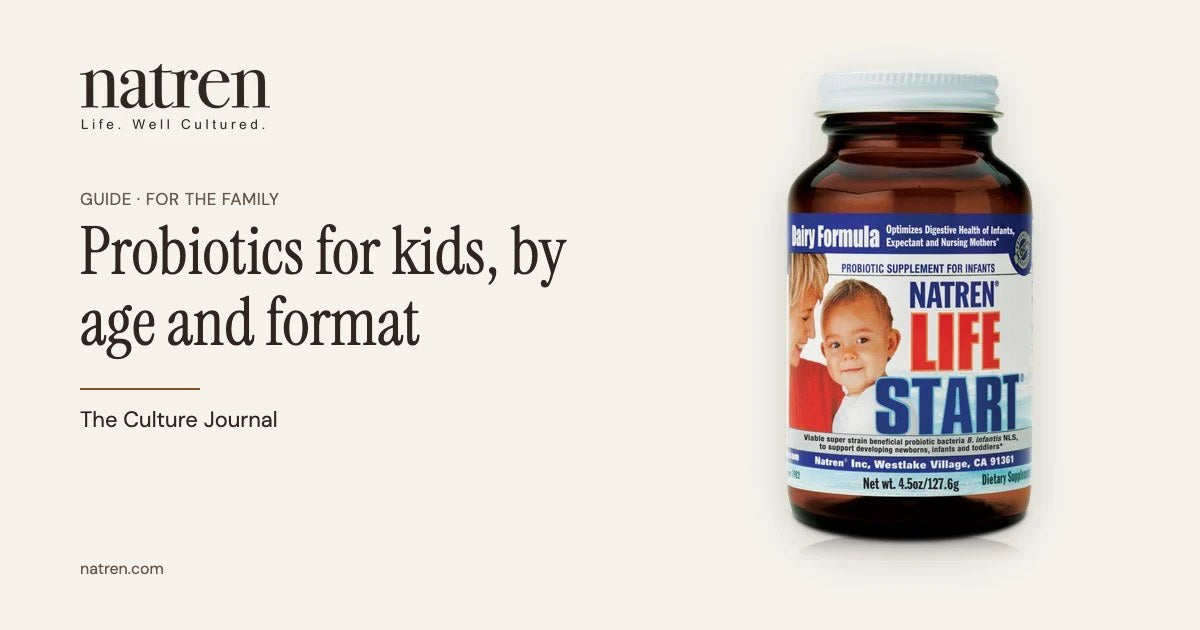
Natren's infant products are the Life Start family. Each is a powder that features a single strain, Bifidobacterium infantis NLS, in a different base:
- Life Start is a probiotic powder featuring B. infantis NLS in a milk-containing (cow's milk) formulation. It comes in 1.25 oz, 2.5 oz and 4.5 oz bottles. Because it contains dairy, it isn't for anyone with a milk allergy.
- Life Start Vegan is the dairy-free version. It's free from dairy, soy and FOS, non-GMO, and provides 1 billion CFU per 1 g serving, with potency guaranteed through the expiration date. It comes in a 1.25 oz bottle.
- Life Start 2 is a goat-milk-based powder featuring B. infantis NLS, in 2.5 oz or 4.5 oz bottles. Ask your pediatrician first if your child has any milk allergy.
Use the serving and mixing directions on your bottle's label for your baby's age. They're the ones to follow.
If a new probiotic doesn't seem to agree with your baby, stop and call your pediatrician. Our article on why some babies react poorly to probiotics covers what parents commonly notice and the questions to ask.
Probiotics for toddlers (1–3 years)
Toddlers are usually still best served by a powder. It mixes into foods they already eat, and the amount can match the label for their age.
- Natren's directions for toddlers suggest mixing the powder into water, a non-acidic juice such as apple or grape, applesauce or yogurt.
- Mix it in just before serving, and use unchilled (not hot) food or liquid.
- Hold off on chewable wafers. The AAP advises keeping hard, choking-risk foods from children until age 4 or older, depending on the child. Natren's Healthy Tummy wafers aren't for children under 4.
Looking for a "natural" toddler probiotic? The label tells you more than that word: the named strain, the base, any added sugars and the count through expiration.
Probiotics for kids (4–12 years)
Once children can chew safely, a wafer can be easier than mixing a powder each day.
- Healthy Tummy is a French vanilla chewable wafer with Lactobacillus bulgaricus LB-51, at 5 calories per wafer, with 1 billion CFU (see the label for the serving size). Natren's directions say not to give chewable wafers to children under 4, because of the risk of choking. Have your child sit down and stay with them while they chew.
- Capsules suit older children who swallow pills comfortably. For Life Start 2 capsules, which feature B. infantis NLS in a goat-milk-based formulation, Natren's directions say not to give them to children under 8, again because of choking risk. Younger children can use a powder instead.
- Adult products: don't assume an adult probiotic suits a child. Check that product's label for age directions, and ask your pediatrician.
Treat chewables as a supplement, not candy, and keep the bottle out of reach. Read are chewable probiotics safe for kids?
Chewables vs powders vs capsules: which format by age?
| Powder | Chewable wafer | Capsule | |
|---|---|---|---|
| Typical age | Infants, toddlers and older children who prefer it | Children who chew safely; Healthy Tummy: not under 4 | Older children who swallow pills; Life Start 2 capsules: not under 8 |
| How it's taken | Mixed into a small amount of liquid or soft food | Chewed, no water needed | Swallowed whole |
| Flexibility | Most flexible; serving can follow the label by age | Fixed per wafer | Fixed per capsule |
| Natren options | Life Start, Life Start Vegan, Life Start 2 powder | Healthy Tummy | Life Start 2 capsules |
| Check | Base (cow's milk, goat milk or dairy-free) | Sugars, flavors, age limit | Age limit, capsule ingredients |
Choose the format your child can take safely and consistently. Our comparison of chewables, capsules and powders has more.

How do you mix a probiotic powder for a child?
Natren's directions call for unchilled liquid. In general:
- Use the amount on the label for your child's age.
- For infants, mix the powder with a small amount of unchilled, filtered water or breast milk into a thin paste, as the label describes.
- For toddlers and older children, water, a non-acidic juice such as apple or grape, applesauce or yogurt all work.
- Avoid hot food or drinks, and mix just before serving.
- Keep it at least two hours apart from herbs, garlic and prescription medicines, as Natren's directions advise. If your child is taking an antibiotic, ask your pediatrician about timing.
Storing children's probiotics: fridge, daycare and travel
Natren products are shipped cold and should be kept refrigerated, not frozen. That includes chewable wafers.
- Put the bottle in the fridge as soon as it arrives, and take out only what you need.
- Natren's Healthy Tummy directions note that wafers removed from the bottle for the day should be used within 24 hours.
- For daycare, school days, trips and sleepovers, give the dose at home where you can, or pack only the day's serving in an insulated bag with a cold pack. Check the label, or ask Natren's team for product-specific guidance.
- Check the expiration date. Natren guarantees potency through expiration when products are stored as directed.
Our refrigeration guide covers what to do if a bottle sat out or arrived warm; our refrigeration page explains how Natren ships cold.
When should you call the pediatrician?
Call your pediatrician before starting a probiotic, and again if anything worries you. Don't wait if your child has signs of dehydration, a high fever, blood in the stool, ongoing vomiting or pain, or isn't feeding or drinking well. Those need medical attention, not a supplement.
If your child has trouble going to the bathroom, start with your pediatrician; our guide to probiotics and occasional constipation covers fiber, fluids and habits.
Still deciding?
Browse the children's collection or the infant and nursing mother collection, try the product finder, or book a free personal consultation with our team. Many Natren products are also available through Subscribe & Save.
Frequently asked questions
Which Natren probiotic for kids is dairy-free?
Life Start Vegan, which is free from dairy, soy and FOS. Life Start contains cow's milk, and Life Start 2 is goat-milk based; goat milk is still milk.
Can I give my newborn a probiotic?
Ask your pediatrician first. They can tell you whether a probiotic is appropriate for your baby and how to give it. Don't give a probiotic to a baby who was born early, is in the hospital or has a weakened immune system unless the baby's medical team recommends it.
What age can kids have chewable probiotics?
Follow the label. Natren's Healthy Tummy wafers aren't for children under 4 because of the risk of choking. Younger children can take a powder mixed into a small amount of liquid or soft food.
How long can Healthy Tummy wafers stay out of the fridge?
Natren's directions note that wafers removed from the bottle for the day should be used within 24 hours. Return the bottle to the refrigerator, and don't freeze it.
These statements have not been evaluated by the Food and Drug Administration. This product is not intended to diagnose, treat, cure, or prevent any disease.
Sources
- U.S. Food and Drug Administration. FDA Raises Concerns About Probiotic Products Sold for Use in Hospitalized Preterm Infants. News release, October 26, 2023. https://www.fda.gov/news-events/press-announcements/fda-raises-concerns-about-probiotic-products-sold-use-hospitalized-preterm-infants
- U.S. Food and Drug Administration. Dear Healthcare Provider Letter: Warning Regarding Use of Probiotics in Preterm Infants. October 2023. https://www.fda.gov/media/172606/download
- Poindexter B; Committee on Fetus and Newborn, American Academy of Pediatrics. Use of Probiotics in Preterm Infants. Pediatrics. 2021;147(6):e2021051485. doi:10.1542/peds.2021-051485. https://pubmed.ncbi.nlm.nih.gov/34031231/
- American Academy of Pediatrics, HealthyChildren.org. AAP Urges Caution in Use of Probiotics in Preterm Infants. May 24, 2021. https://www.healthychildren.org/English/news/Pages/Caution-in-Use-of-Probiotics-in-Preterm-Infants.aspx
- American Academy of Pediatrics, HealthyChildren.org. Choking Prevention for Babies & Children: What Every Parent Needs to Know. Last updated February 27, 2026. https://www.healthychildren.org/English/health-issues/injuries-emergencies/Pages/Choking-Prevention.aspx
- National Center for Complementary and Integrative Health (NCCIH). Probiotics: What You Need To Know. https://www.nccih.nih.gov/health/probiotics-what-you-need-to-know
- National Institutes of Health, Office of Dietary Supplements. Probiotics: Fact Sheet for Consumers. https://ods.od.nih.gov/factsheets/Probiotics-Consumer/
- National Institutes of Health, Office of Dietary Supplements. Probiotics: Fact Sheet for Health Professionals. https://ods.od.nih.gov/factsheets/Probiotics-HealthProfessional/
- Natren product pages: Life Start, Life Start Vegan, Life Start 2 powder, Life Start 2 capsules, Healthy Tummy (product descriptions checked November 12, 2026).


Join the conversation