
Short answer: a good dog probiotic tells you exactly what's in it and how much. Look for named strains (not just species), a live-culture count per serving that's guaranteed through the expiration date, a serving size by your dog's weight, a short ingredient list with nothing harmful to dogs, and clear storage directions. Then check with your veterinarian before you start, especially if your dog takes any medicine or is under veterinary care.
This guide walks through each part of a dog probiotic label, explains whether dogs can take human probiotics, and shows how Natren's dog products read against the checklist. For a broader look at pet probiotics, routines, travel and boarding, see our practical guide for dog and cat owners.
1. Named strains, not just species
A label that says only "Lactobacillus acidophilus" or "probiotic blend" tells you the species at most. A full name adds a strain code, such as L. acidophilus NAS or Enterococcus faecium NCIMB 10415. Strains within a species can differ, so the code is what lets you, or your vet, look up what the product actually contains. Our guide to Lactobacillus acidophilus explains why the strain code matters.
2. A count you can trust: CFU through expiration
Probiotics are measured in colony-forming units (CFU), an estimate of the live cultures in a serving. Check two things:
- Per serving, not per container. A big number for the whole bottle doesn't tell you what your dog gets each day.
- Through expiration, not "at time of manufacture". Live cultures decline over time, so a count at manufacture says little about what's left months later.
3. Serving size by weight
Dogs range from a few pounds to well over a hundred, so the label should tell you how much to give for your dog's size, or tell you to ask your vet. Avoid products that give one serving for every dog.
4. The other ingredients
Read the full ingredient list, not just the probiotic. Flavorings, fillers and sweeteners vary a lot between products. In particular, never give a dog anything containing xylitol, a sweetener found in some human foods and supplements, because it's toxic to dogs. If an ingredient is unfamiliar, ask your vet before using the product.
5. A format your dog will take
- Gel in an oral syringe: easy to measure and give directly or from your finger.
- Powder: mixes into food or water, which suits dogs who won't take anything on its own.
- Chews and treats: convenient, but check the count per chew and the other ingredients carefully.
The best format is the one you can give consistently, at the same time each day.
6. Storage directions
Heat and moisture reduce live cultures. If the label says to refrigerate, the product should have been kept cold all the way to you, and it should stay in the refrigerator at home, with the cap on. Read more in our guide to probiotic storage.
Can dogs take human probiotics?
Ask your vet before giving your dog any human supplement. Human probiotics are formulated, dosed and flavored for people, and some contain ingredients that aren't suitable for dogs, such as sweeteners or flavorings. A product made for dogs gives a serving size by the dog's weight and lists ingredients chosen with dogs in mind. If your vet does suggest a human product, have them check the label and the amount first.
How Natren's dog probiotics read against the checklist
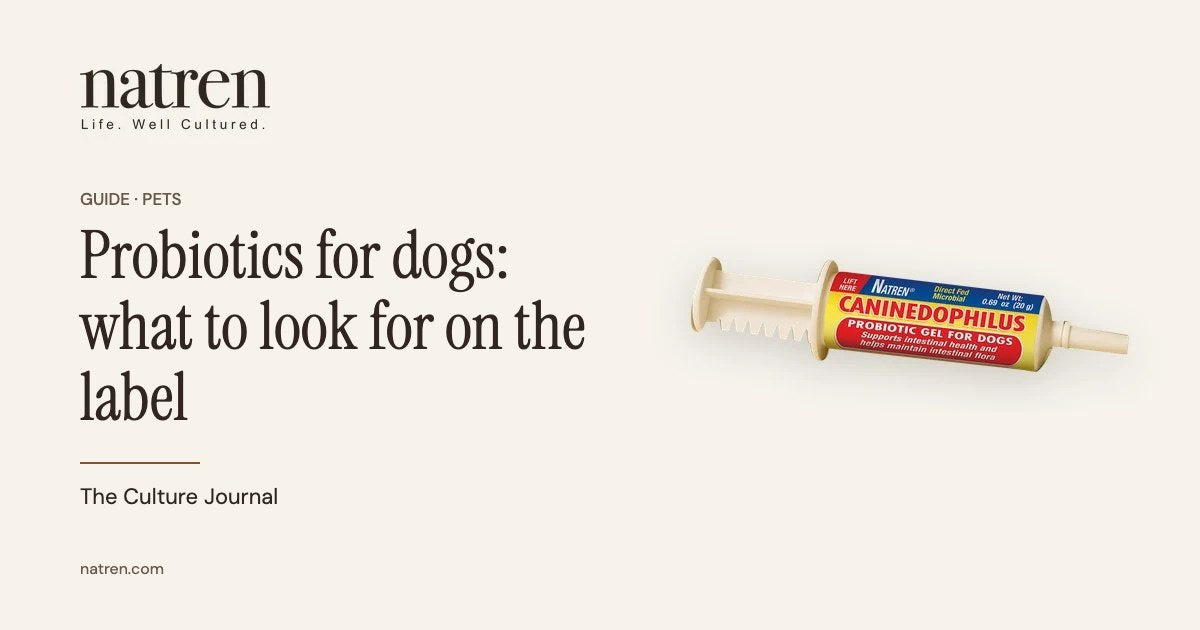
Caninedophilus is a refrigerated probiotic gel for dogs in an oral syringe:
- Strains: Lactobacillus acidophilus NAS and Enterococcus faecium NCIMB 10415. The E. faecium strain (recently reclassified by scientists as Enterococcus lactis NCIMB 10415) has been assessed by the European Food Safety Authority (EFSA) and is authorized in the EU as a feed additive for dogs and cats.
- Count: 3 billion CFU per gram, or 6 billion CFU per 2 g serving, with 10 servings per syringe. Potency is guaranteed through the printed expiration date when stored as directed.
- Serving: 1 to 2 g, or as directed by your veterinarian, ideally with food.
- Storage: keep refrigerated.
- Also available as a three pack.
Gastro Vegi-Dophilus is a dairy-free probiotic powder for dogs, cats and other pets:
- Strains: Lactobacillus acidophilus DDS-1 (4 billion CFU per gram) and Lactobacillus bulgaricus LB-51 (2 billion CFU per gram), with potency guaranteed through the expiration date.
- Serving: 1 g per 10 lbs of body weight, mixed into food or water.
- Storage: keep refrigerated.
Natren's product copy describes Caninedophilus as supporting digestive health and a balanced gut.* As with any supplement, ask your veterinarian before use if your dog is under veterinary care. Both products are in the pet probiotics collection; cat owners can look at Felinedophilus.
FAQ
When do owners usually think about a probiotic for their dog?
Often around changes in routine: a new food, travel, boarding or a new home. If your dog has any symptoms, such as changes in appetite, stools or energy, see your vet rather than starting a supplement.
Should I give it with food?
Follow the label. Caninedophilus is best given with food, and Gastro Vegi-Dophilus mixes into food or water.
Can I give my dog yogurt instead?
Plain yogurt is a food, not a measured probiotic, and many yogurts contain sugar or sweeteners, including xylitol in some products, that dogs shouldn't have. Ask your vet whether yogurt suits your dog and how much.
Do I need to refrigerate a dog probiotic?
If the label says so, yes. Natren's pet probiotics are shipped cold and should be kept in the refrigerator, not the freezer.
*These statements have not been evaluated by the Food and Drug Administration. This product is not intended to diagnose, treat, cure or prevent any disease.


Join the conversation