
Short answer: Many healthy adults take a probiotic every day as one part of a routine that supports digestive health, alongside a good diet, sleep and exercise. The reasoning is mostly about consistency. Probiotics are live microbes, and the habit is easiest to keep when it is simple, steady and built around a product whose strains and storage you understand.
Diet comes first
If you already eat mostly whole foods, you are doing the most important thing. Fiber from vegetables, fruit, beans and whole grains feeds the microbes in your gut, and fermented foods add live cultures. Good options include:
- Yogurt and kefir labeled as containing live and active cultures
- Refrigerated, unpasteurized sauerkraut and kimchi
- Miso and tempeh
- Pickles fermented in brine (most shelf-stable pickles are made with vinegar instead)
Fermented foods are worth enjoying for their own sake. What they usually can't tell you is exactly which strains you are getting or how many are still alive when you eat them. That is where some people add a supplement: it provides identified strains in a consistent amount each day. For a refresher on the gut community itself, see Microbiota 101.
Why consistency matters
Probiotics are live microorganisms that are intended to have health benefits when consumed, according to the National Center for Complementary and Integrative Health (NCCIH). NCCIH says probiotics might help the body maintain a healthy community of microorganisms, produce substances that have desirable effects, and influence the body's immune response. It also notes that different types of probiotics may have different effects.
The NIH Office of Dietary Supplements says probiotics may colonize the gut transiently, in patterns that vary with the person and the strain. In other words, most supplemental strains are thought to pass through the digestive tract rather than settle in permanently. That is one reason people who take probiotics tend to take them regularly rather than now and then.
Daily life also shifts. Travel, a busy stretch at work, irregular meals or a course of antibiotics prescribed by your doctor can all change your routine. A daily probiotic is one steady piece that doesn't depend on what else the week brings, and it fits naturally next to other daily habits such as a fiber-rich breakfast or an evening walk.
Seasonal routines: winter and travel
Colder months tend to disrupt routines: holiday meals, travel, shorter days, less time outdoors and often fewer fresh fruits and vegetables. If a daily probiotic is already part of your routine, winter is simply a time to keep it going alongside the basics that matter most:
- Keep meals varied, with vegetables, fruit, beans, whole grains and fermented foods, even when routines change.
- Protect your sleep and stay active, indoors if you need to.
- Wash your hands often, and stay home when you're unwell.
- Ask your doctor or pharmacist about seasonal vaccines, such as the annual flu shot.
- Plan for travel: pack a refrigerated probiotic in a small insulated bag with a cold pack.
A probiotic is not a substitute for a flu vaccine, medical advice or treatment. If you have flu symptoms, or you're in a higher-risk group, contact your doctor.
Building a daily routine
- Pick a consistent time. Many people take their probiotic with a light meal, such as breakfast. Doing it the same way each day matters more than the exact hour.
- Anchor it to a habit. Keeping the bottle in the refrigerator next to something you reach for every morning makes it easy to remember.
- Space it from antibiotics. If your doctor prescribes an antibiotic, a common approach is to take the probiotic about 2 hours apart. Follow the label and your doctor's advice.
- Follow the label. Serving directions vary by product, so use the label as your guide rather than a general rule.
- Pay attention as you start. Some people notice occasional gas or bloating when they begin a new probiotic. If anything concerns you, check with your doctor.
Our guide to when to take probiotics goes into more detail on timing.
Choose by strain, not just by name
The word "probiotic" on a label tells you very little by itself. What matters is the specific strain, written as genus, species and strain ID, such as Lactobacillus acidophilus NAS or Bifidobacterium bifidum Malyoth. A few questions help when comparing products:
- Does the label identify each strain by its full name, including the strain ID?
- Is the live culture count stated through the expiration date, or only at the time of manufacture?
- Does the format suit you: capsule, powder or chewable? Dairy, dairy-free or vegan?
- Are the storage instructions clear?
Our strain guide explains what these names and IDs mean.
Storage: keep it cold
Probiotics are living organisms, and heat and moisture can reduce how many stay alive. Store yours exactly as the label says. Natren makes its products in its own California facility, keeps them refrigerated and ships them cold in thermal packaging. When your order arrives, put it in the refrigerator and keep the lid tightly closed. Healthy Trinity, for example, should be kept refrigerated and not frozen. Avoid leaving any probiotic near the stove, in a sunny window or in a hot car. Our help and FAQ page covers shipping and storage questions.
Where Natren fits
If you are looking for a daily probiotic, Natren offers a few straightforward starting points:
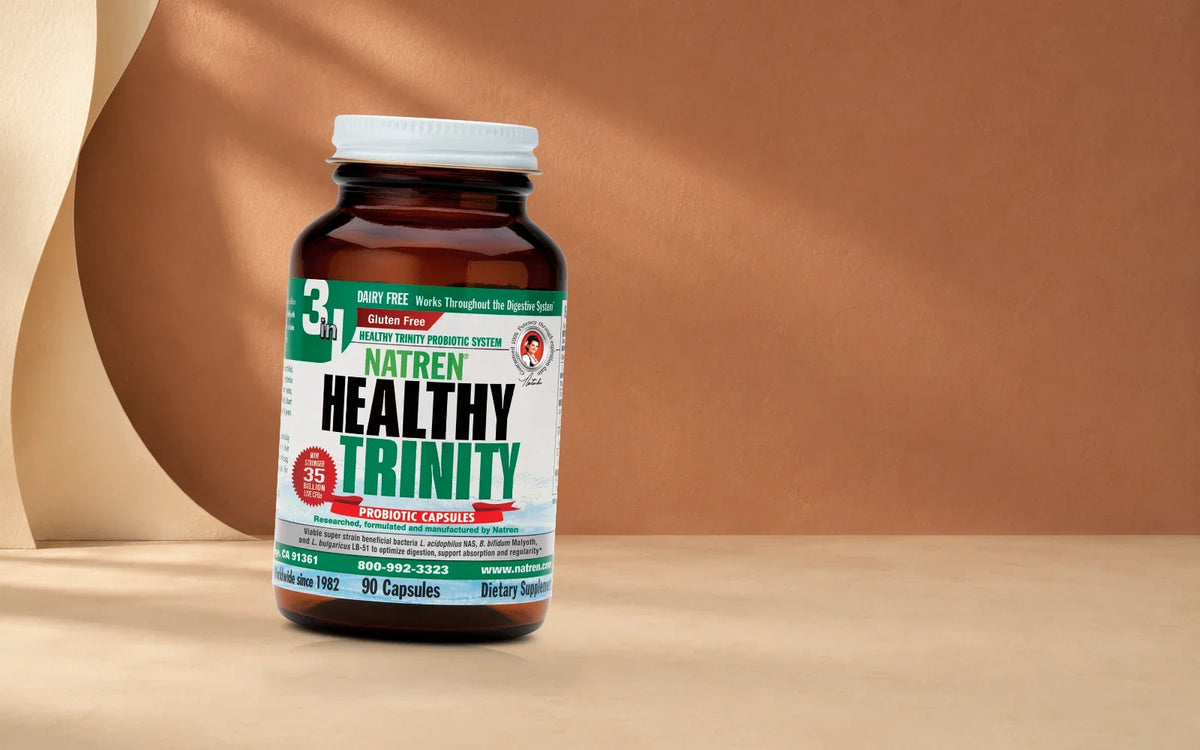
- Healthy Trinity combines three strains, L. acidophilus NAS, B. bifidum Malyoth and L. bulgaricus LB-51, in an oil-based capsule. It contains gelatin and comes in 30, 60 and 90 capsule sizes.
- Megadophilus features a single strain, L. acidophilus NAS, in dairy, dairy-free and vegan formulas.
- Bifido Factor features B. bifidum Malyoth, in capsules, a dairy powder or a vegan powder.
Natren probiotics are made to support digestive health and a healthy intestinal environment.
These statements have not been evaluated by the Food and Drug Administration. These products are not intended to diagnose, treat, cure, or prevent any disease.
Whichever you choose, follow the label. For children, ask your pediatrician before starting any probiotic. If you have a health condition, are pregnant or take medications, talk with your doctor first.
Frequently asked questions
Do I need a probiotic if I already eat fermented foods?
Not necessarily. A varied, fiber-rich diet with fermented foods comes first. Fermented foods usually can't tell you which strains you are getting or how many are still alive, so some people add a supplement for identified strains in a consistent amount each day.
What time of day should I take a daily probiotic?
There's no single best hour. Many people take theirs with a light meal such as breakfast, and doing it the same way each day matters more than the exact time. Follow the label, and keep it about 2 hours apart from any antibiotic your doctor prescribes.
Should I keep taking a probiotic through winter?
If a daily probiotic is already part of your routine, you can simply keep it going through winter. It isn't a substitute for a flu vaccine or medical care, so talk to your doctor about seasonal vaccines and about any symptoms.
Why take a probiotic every day rather than now and then?
Most supplemental strains are thought to pass through the digestive tract rather than settle in permanently. That is one reason people who take probiotics tend to take them regularly.
These statements have not been evaluated by the Food and Drug Administration. These products are not intended to diagnose, treat, cure, or prevent any disease.
Sources
All URLs checked November 15, 2026.
- National Center for Complementary and Integrative Health. Probiotics: Usefulness and Safety. Last updated August 2019. https://www.nccih.nih.gov/health/probiotics-usefulness-and-safety
- National Institutes of Health, Office of Dietary Supplements. Probiotics: Fact Sheet for Health Professionals. https://ods.od.nih.gov/factsheets/Probiotics-HealthProfessional/


Join the conversation